 bitsepi@gmail.com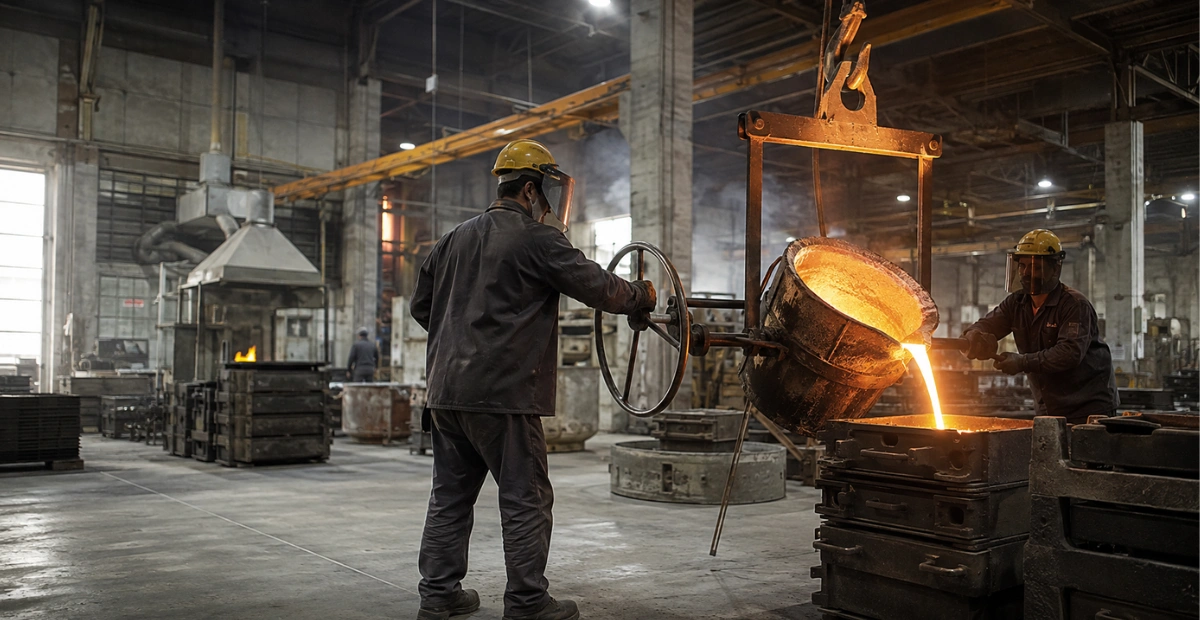
Manufacturing an industrial cast iron component involves much more than pouring molten metal into a mould. Final quality is the result of a connected production chain beginning with material preparation and continuing through melting, moulding, casting, cooling, finishing, coating, inspection and packing.
For components used in home appliances, dimensional accuracy and repeatability are particularly important because the finished part must be compatible with an existing product and assembly process.
How are cast iron components manufactured?
The exact route depends on component geometry, dimensions, material requirements, tooling and customer specifications. However, the principal stages of an industrial process commonly include material preparation, melting, mould preparation, casting, cooling, cleaning and finishing, surface treatment and final quality control.
1. Material preparation
Production begins with the selection and preparation of the materials required for the specified casting. The condition and composition of the charge must be managed in accordance with the intended production process.
A stable approach at this stage provides the foundation for greater consistency in the subsequent melting and casting operations.
2. Melting
Prepared material is melted under controlled production conditions. The objective is not simply to turn solid material into liquid metal; the melt must be in an appropriate condition for the casting operation.
Process monitoring is important because industrial customers require repeatable results over a production run rather than a single successful casting.
3. Moulding
The mould defines the basic geometry of the component. Arms, feet, supports, thickness transitions and other features must be represented correctly so that the casting can meet its dimensional and functional requirements.
Mould quality can also influence surface condition and the amount of finishing required later in the process.
4. Casting
Molten material is transferred into the prepared mould where it fills the designed cavity and begins to solidify.
Components such as gas stove grates may include multiple branches, contact points and changes in section. The casting process therefore has to be planned and executed according to the geometry of the individual part.
5. Cooling and removal
After pouring, the casting must solidify and cool sufficiently before subsequent operations. Cooling conditions are managed according to the component and production method.
Once ready, the component is removed and prepared for cleaning and finishing.
6. Cleaning, grinding and finishing
A newly removed casting is not yet a finished appliance component. Unwanted material associated with the casting process must be removed and relevant surfaces must be completed.
Grinding and finishing operations improve the final form and prepare the component for its required surface treatment.
7. Enamelling or surface treatment
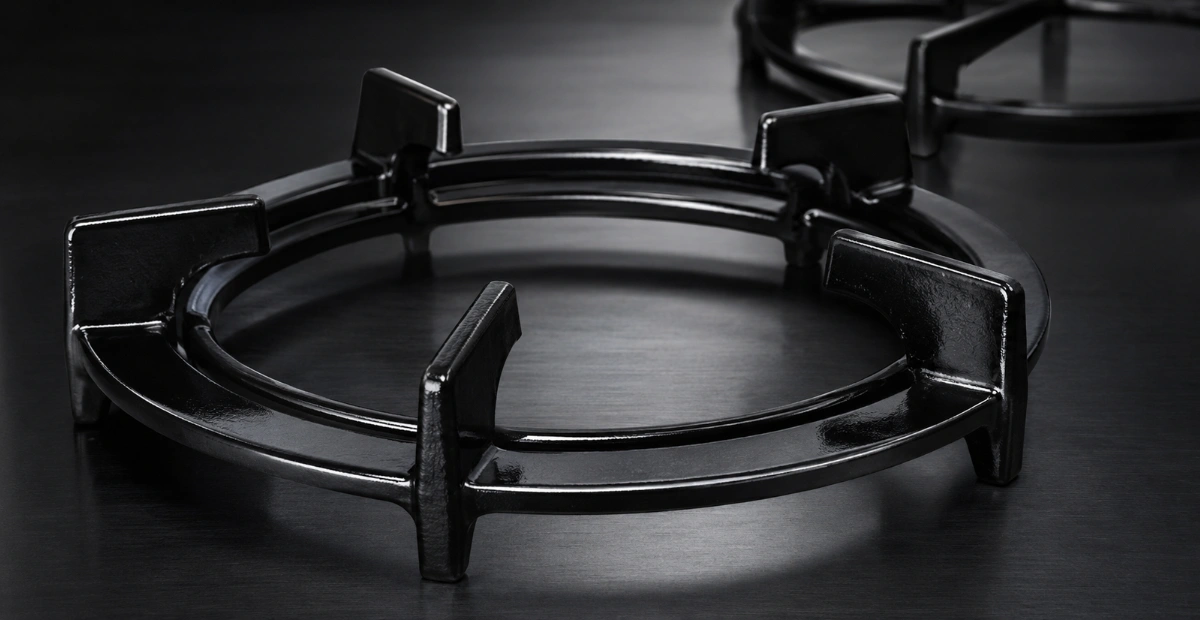
For many visible cast iron appliance components, enamel may form part of the final product specification. Surface preparation is important before coating is applied.
The finished coating can then be inspected for factors such as coverage, uniformity, colour and overall appearance according to the agreed requirements.
8. Final inspection and packing
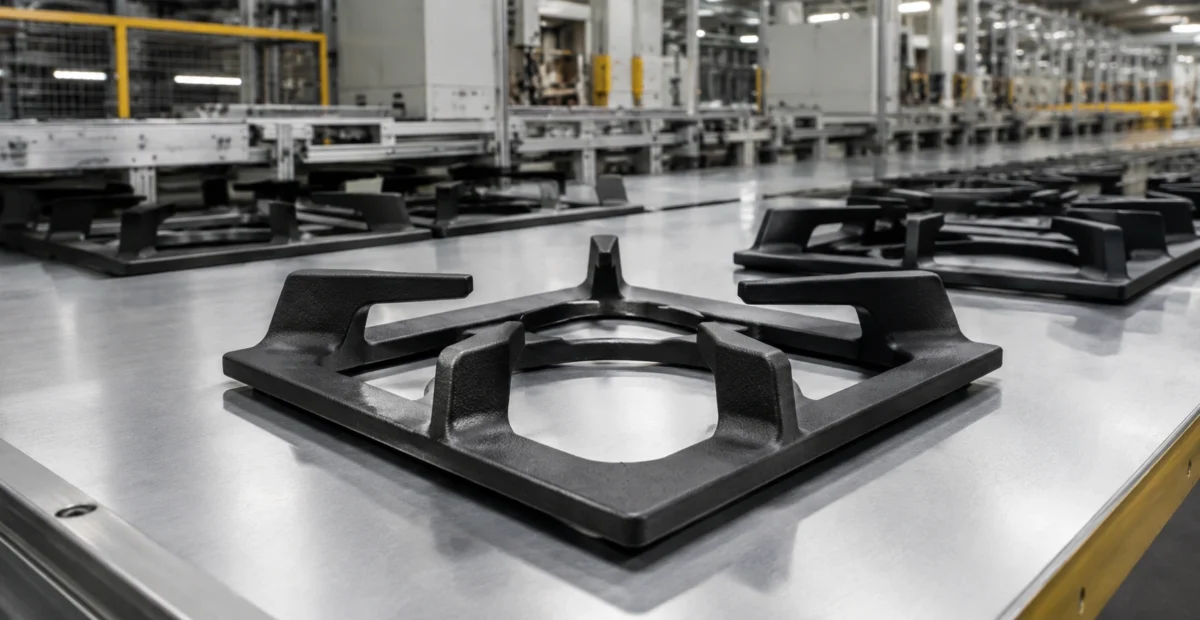
Before delivery, components are inspected against the specifications of the order. Typical inspection areas include dimensions and geometry, visual condition, finishing quality and coating appearance.
Non-conforming components should be separated from approved products so that an appropriate decision can be made regarding rework, correction or rejection.
Approved parts are then packed for delivery and integration into the customer’s production process.
Why quality control should happen throughout production
If a process problem is discovered only during final inspection, a larger quantity of components may already have been affected. For this reason, industrial quality control is most effective when it is integrated into multiple stages of production.
Material checks, process monitoring, raw casting inspection, dimensional measurement and final surface inspection can identify different types of non-conformity at earlier stages.
Key inspection criteria for cast iron parts
Dimensions and geometry
Critical measurements, overall geometry and contact or assembly points are checked against the agreed technical specification.
Visual condition
Visible surfaces are examined for unacceptable defects or irregularities.
Finishing quality
Grinding, removal of unwanted material and the resulting surface condition are evaluated.
Enamel and coating quality
Where coating is required, its appearance, uniformity and colour are checked according to the project specification.
How does custom cast iron production begin?
A custom project generally starts with a drawing, sample or technical specification supplied by the customer. The manufacturer then evaluates geometry, dimensions, surface requirements, expected production volume and overall manufacturability.
A sample can be produced for technical evaluation before volume production begins. This allows both the component and assembly compatibility to be reviewed at an earlier stage.
Why repeatability matters in B2B manufacturing
Industrial customers rarely need only one good component. Parts must be supplied in volume and often across repeated production orders.
A suitable manufacturing partner must therefore demonstrate not only the ability to create an acceptable sample but also the ability to maintain agreed characteristics throughout production.
Cast iron production at AALFA PLUS
AALFA PLUS follows a production route covering material preparation, melting, moulding, casting, cooling, grinding and finishing, enamelling, inspection and packing for cast iron appliance components.
In addition to existing product models, custom components can be evaluated based on technical drawings, dimensions or reference samples.
Conclusion
Cast iron quality is not created by a single production stage. It is the result of coordinated control across the entire manufacturing route.
For appliance manufacturers, understanding this process is valuable when selecting a long-term supplier. A manufacturer capable of managing specifications, production stages and acceptance criteria in a structured way is better positioned to support consistent industrial supply.