 bitsepi@gmail.com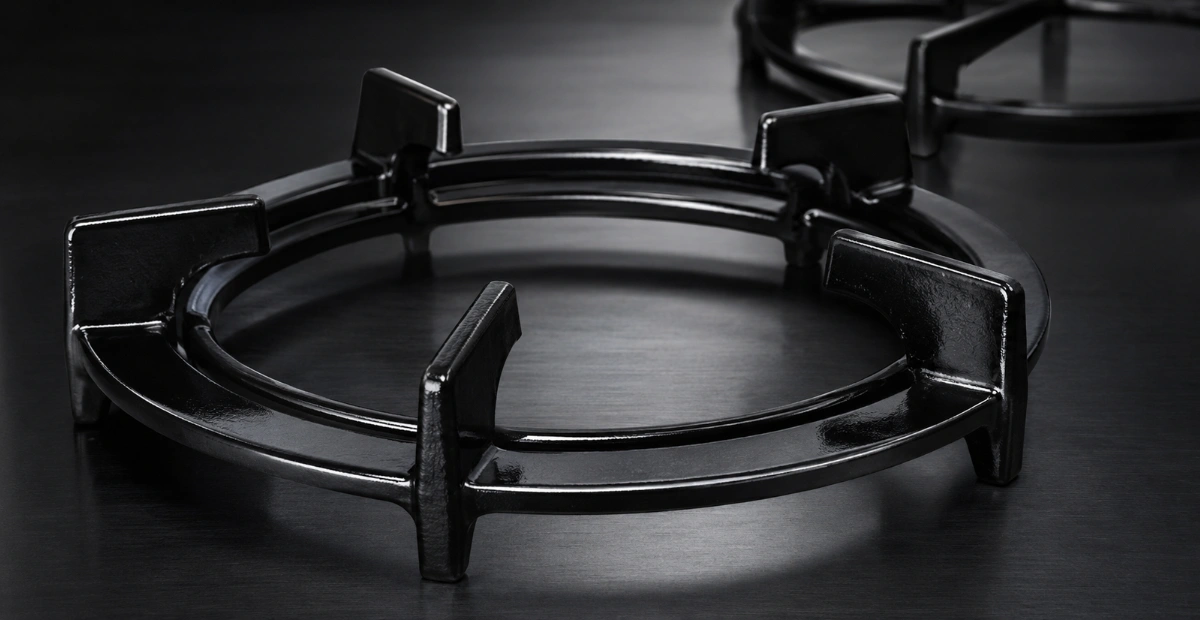
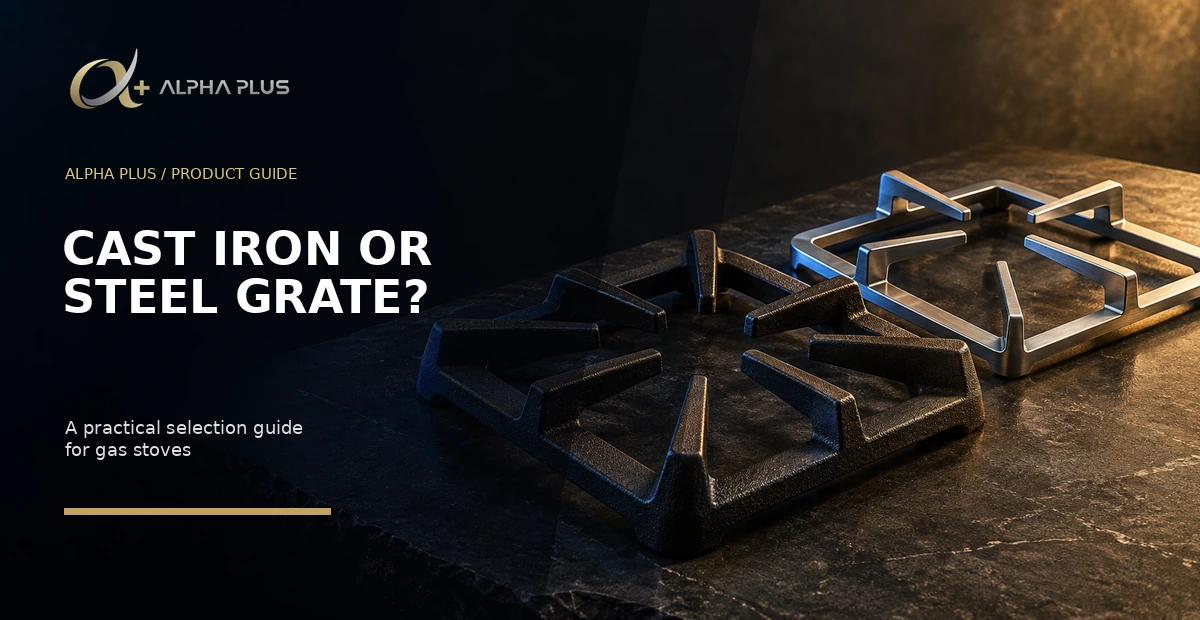
A cast iron grate may look like a relatively simple component, but it plays an important role in the overall performance, appearance and usability of a gas cooktop. For appliance manufacturers, choosing the right grate is therefore not simply a matter of selecting an attractive shape.
Dimensions, geometry, cookware stability, burner positioning, contact points, surface finishing, coating quality and consistency in mass production all need to be considered before a grate is approved for an assembly line.
This guide explains the main technical and practical factors manufacturers should evaluate when selecting or developing cast iron grates for gas stoves and cooktops.
Why is cast iron widely used for gas stove grates?
Cast iron is commonly used for components that need a combination of rigidity, mass, durability and resistance to repeated heating. A gas stove grate is regularly exposed to cookware loads, heat and cleaning throughout the service life of the appliance.
Its weight can provide a stable support platform, while the casting process allows manufacturers to create different geometries suited to a wide range of cooktop designs.
1. Match the grate dimensions to the cooktop
Dimensional compatibility is one of the first considerations. Overall length, width, height, support locations and contact points must correspond to the design of the cooktop.
Even relatively small dimensional variations can affect assembly, positioning or stability. For industrial production, a grate should therefore be evaluated against a technical drawing, approved reference sample or clearly defined dimensional specification.
2. Evaluate cookware stability
One of the grate’s primary functions is to support cookware securely. The arrangement of arms and support points should accommodate the cookware sizes expected to be used with the appliance.
If support points are too far apart, smaller pans may be less stable. If the design is unnecessarily dense, it may increase weight or conflict with the intended appearance of the cooktop.
The correct geometry is therefore a balance between stability, product design, burner arrangement and manufacturing requirements.
3. Consider the grate-to-burner relationship
The height and geometry of the grate determine where the cookware sits in relation to the burner system. This relationship should not be evaluated independently from the burner head, cooktop surface and other components.
Appliance manufacturers should treat the grate as part of a complete system rather than as an isolated component.
4. Check feet and contact points
A grate should sit correctly on the cooktop and remain stable during normal use. The geometry and position of its feet or contact points are therefore critical.
Production tolerances must also be considered. A single prototype that fits correctly does not necessarily guarantee repeatable performance in mass production. Consistent dimensions and geometry are essential for reliable industrial assembly.
5. Surface quality matters
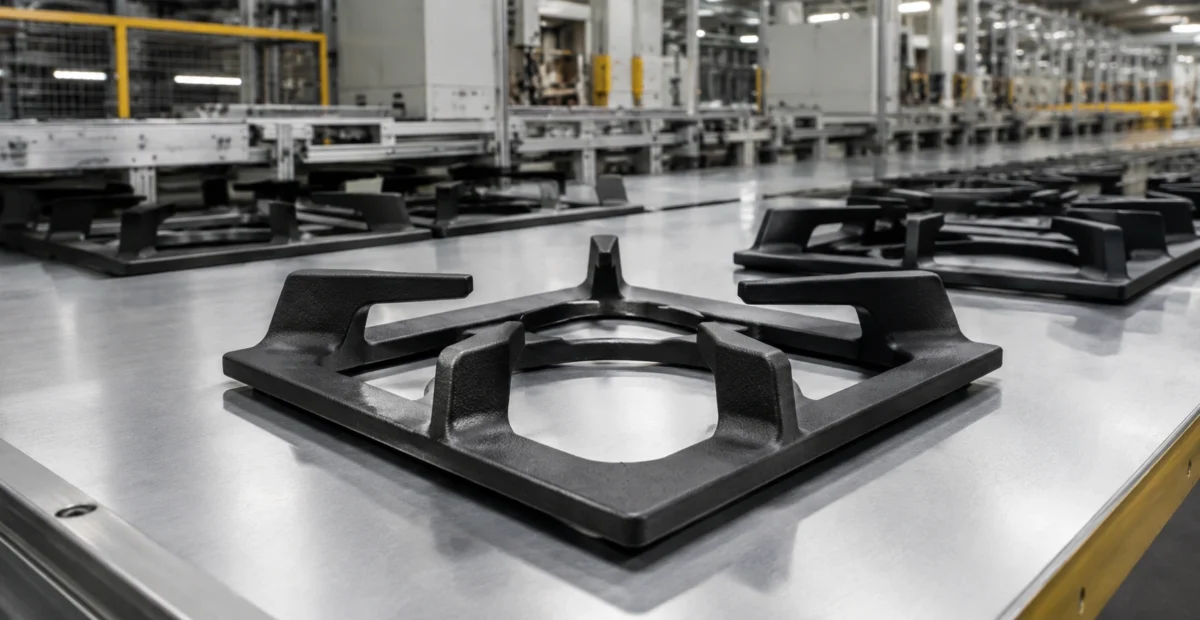
The cast iron grate is a visible part of the finished appliance. Poor grinding, unwanted casting residue, irregular surfaces or inconsistent coating can reduce the perceived quality of the entire cooktop.
Grinding and finishing operations are used after casting to remove unwanted material and prepare the component for its final surface treatment.
6. Enamelled or uncoated cast iron?
The required surface finish should be defined according to the appliance design and performance requirements. Enamel coating can provide a more uniform finished appearance and allows the grate surface to be integrated with the visual identity of the appliance.
For industrial orders, coating type, colour, acceptable appearance and inspection criteria should be agreed before production begins.
7. Consistency in volume production is essential
For an appliance manufacturer, approving one excellent prototype is not enough. Components delivered in production volumes must remain consistent in dimensions, geometry, surface condition and appearance.
Quality control is therefore most effective when it is integrated into the production process rather than limited to final inspection.
8. Standard model or custom grate?
A standard grate can be the right solution when an existing model is compatible with the cooktop geometry and assembly requirements.
For a new appliance platform or a distinctive cooktop design, however, a custom part based on a drawing or physical sample may be more appropriate.
A custom project normally requires clear information about dimensions, critical contact points, required finish, coating specifications, expected production volume and acceptance criteria.
What information should be prepared before ordering?
- Technical drawing or physical reference sample
- Overall and critical dimensions
- Locations of feet and contact points
- Cooktop and burner configuration
- Required surface finish
- Enamel or coating requirements
- Expected order volume
- Inspection and acceptance criteria
- Packing and delivery requirements
How should a cast iron grate supplier be evaluated?
Unit price is important, but it should not be the only purchasing criterion. Consistent production, dimensional control, surface quality, coating capability, technical communication and the ability to manufacture from drawings or samples can have a significant impact on the efficiency of an appliance production line.
Components requiring extensive sorting, correction or rework may create costs that are considerably greater than a small difference in purchase price.
AALFA PLUS cast iron grates
AALFA PLUS manufactures cast iron grates and components for home appliance manufacturers. Existing grate models can be evaluated for industrial orders, while custom components can also be reviewed based on drawings, dimensions or physical samples.
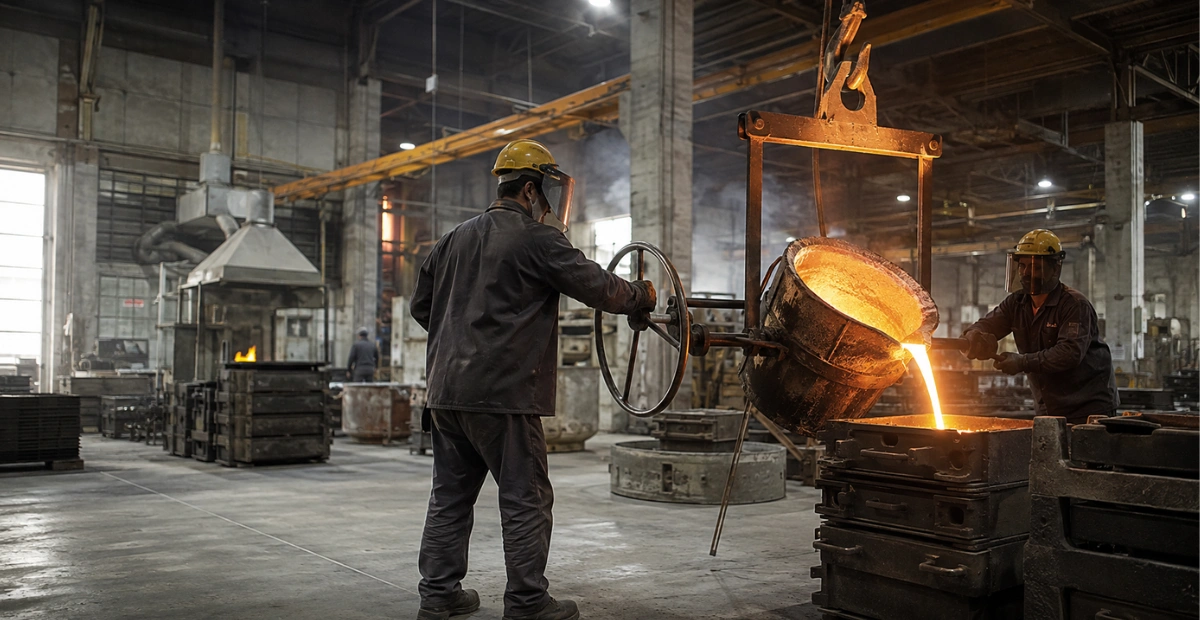
The production route includes material preparation, melting, moulding, casting, controlled cooling, grinding and finishing, enamelling, inspection and packing. Quality requirements are reviewed according to the technical specifications of each order.
Conclusion
Choosing the right cast iron grate requires more than selecting a model with the right appearance. Dimensions, cookware stability, geometry, contact points, height, finishing, coating and production consistency should all be evaluated together.
For appliance manufacturers, the most reliable approach is to evaluate the grate as part of the complete cooktop assembly and approve technical samples before entering volume production.